3D Printing Car Parts: What's Possible, What's Safe, and What Actually Works
A practical guide to 3D printing car parts in the UK. Learn what can be safely printed, what should be avoided, material selection, legal considerations, and when 3D printing makes sense for vehicle repairs.
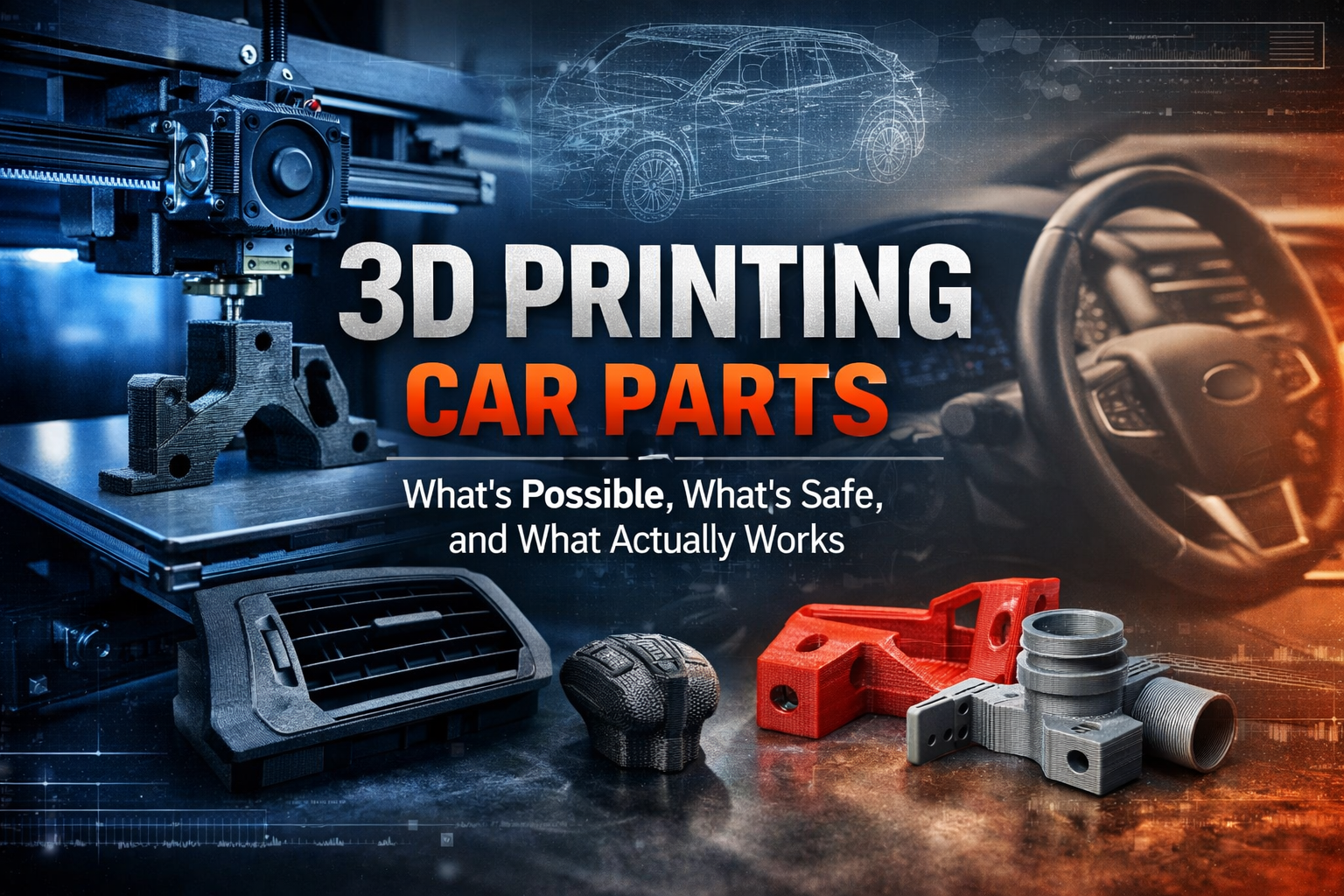
3D printing car parts - what's safe and what actually works
3D Printing Car Parts: What's Possible, What's Safe, and What Actually Works
3D printing car parts is often framed as either the future of automotive manufacturing or an unnecessary risk. The reality sits somewhere in between. When used appropriately, 3D printing offers a practical way to repair, adapt, and extend the life of vehicles. When used without a clear understanding of its limits, it can create safety, legal, and durability issues.
This article explores the real-world use of 3D printing for car parts, focusing on what works today, what should be avoided, and how to approach the technology responsibly.
Why 3D Printing Car Parts Is Gaining Attention
Automotive manufacturing is optimised for scale. Once a vehicle model ages or demand drops, replacement parts can become expensive or disappear entirely. This is where 3D printing becomes relevant.
Rather than competing with mass production, 3D printing fills the gaps it leaves behind. It allows small garages, engineers, and vehicle owners to produce low-volume or one-off parts on demand. For older vehicles, specialist models, or custom builds, this can be the difference between a repair being viable or not.
Key Value Proposition
3D printing car parts makes sense when availability, not performance, is the primary problem. It's a solution for obsolete parts, not a replacement for OEM manufacturing.
What Car Parts Can Be 3D Printed Successfully
The most reliable 3D-printed car parts share a common characteristic: they are not safety-critical.
Interior trim pieces, clips, brackets, housings, vents, and ducting are frequently printed with good results. These components experience relatively low mechanical loads and benefit from the flexibility and customisation that additive manufacturing provides.
✅ Suitable for 3D Printing
Interior trim and non-structural components work well for 3D printing:
- Dashboard trim pieces and bezels
- Air vent louvers and ducts
- Door handle components (non-locking)
- Centre console brackets and clips
- Cable management clips
- Under-bonnet covers (non-heat zones)
- Cosmetic panels and badges
Why these work: Low mechanical stress, minimal safety implications, and easy to replace if they fail.
❌ Not Suitable for 3D Printing
Safety-critical and structural components should never be 3D printed at consumer level:
- Brake components (callipers, pedals, master cylinder parts)
- Suspension parts (arms, mounts, bushings)
- Steering components (columns, racks, tie rods)
- Seatbelt mechanisms and anchors
- Wheels and wheel spacers
- Engine mounts under high load
- Structural chassis components
Why these don't work: Unpredictable failure modes, inability to test fatigue resistance, and serious safety consequences.
These applications align well with common search intent around "what car parts can be 3D printed" and "is it safe to 3D print car parts". The answer is not a blanket yes or no, but a qualified, use-case-driven assessment.
Important Safety Note
Even when a printed part appears strong, predicting its long-term behaviour under vibration, heat cycling, and fatigue is extremely difficult without industrial testing and certification. In safety-critical cases, failure has serious consequences, making traditional manufacturing the only responsible option.
Heat, Stress, and Durability in Automotive Environments
One of the most common causes of failure in 3D-printed car parts is poor material selection. Vehicles expose components to sustained heat, UV radiation, vibration, and chemical contact. Interior parts can deform under prolonged sunlight, while under-bonnet components face far harsher conditions.
A part that performs well in a workshop may fail quickly once installed in a vehicle. This is why discussions about 3D printing car parts inevitably return to material properties such as heat resistance, impact strength, and long-term creep.
| Material | Heat Resistance | Strength | Best For |
|---|---|---|---|
| PLA | 50-60°C | Low | Prototypes only (not suitable for cars) |
| PETG | 70-80°C | Medium | Interior trim, low-stress brackets |
| ABS | 90-100°C | Medium-High | Dashboard parts, interior housings |
| ASA | 90-100°C | Medium-High | UV-resistant exterior trim |
| Nylon (PA6) | 120-150°C | High | Functional parts, under-bonnet (moderate temps) |
| PAHT-CF (PA12 + CF) | 194°C | Very High | Under-bonnet parts, high impact resistance |
| PET-CF | 205°C | Very High | Excellent for under-bonnet parts (best HDT) |
| Polycarbonate (PC) | 130-140°C | Very High | High-stress interior components |
| PC-CF (Polycarbonate + CF) | 140-150°C | Extreme | Maximum strength/heat applications |
Material Selection Matters Most
In practical terms, filament choice matters more than the printer itself. The printer controls accuracy; the material determines survivability. A £200 printer with PET-CF will outlast a £2,000 printer with PLA for automotive applications.
Carbon Fibre Reinforced Filaments: The Under-Bonnet Question
Carbon fibre reinforced filaments deserve special attention because they're often marketed as "automotive-grade" materials. While they do offer significant advantages, understanding their limitations is crucial for under-bonnet applications.
PET-CF (Polyethylene Terephthalate with Carbon Fibre)
PET-CF has emerged as one of the best materials for automotive 3D printing, combining excellent heat resistance with practical printability.
Key Specifications (Bambu Lab PET-CF):
- Heat Deflection Temperature: 205°C (as-printed)
- Bending Strength: 131 MPa
- Bending Modulus (Stiffness): 5320 MPa
- Water Absorption: 0.37% (very low)
- Price: ~£79/kg
Advantages:
- Excellent heat resistance (205°C HDT - higher than most PA-based filaments)
- Outstanding stiffness (5320 MPa - higher than PAHT-CF at 4230 MPa)
- Very low moisture absorption (0.37% vs 0.88% for PAHT-CF)
- No drying required before printing or during storage
- No enclosure needed for printing
- Hardened steel nozzle required (0.4-0.6mm)
- Better dimensional stability than PETG or ABS
- Good surface finish as-printed
PET-CF: Excellent for Under-Bonnet Use
PET-CF is suitable for most under-bonnet applications straight from the printer. With a 205°C heat deflection temperature, it exceeds typical engine bay temperatures (80-120°C) with substantial safety margin.
This makes PET-CF the most practical choice for under-bonnet brackets, mounts, and components - no annealing required, no drying needed, no enclosure necessary.
Typical engine bay temperatures:
- Upper engine bay: 70-90°C
- Radiator area: 80-100°C
- Near engine block: 90-120°C
- Around exhaust manifold: 150-200°C+ (avoid PET-CF here)
Still not suitable for:
- Direct exhaust contact (200-600°C)
- Turbocharger proximity (200-300°C)
- Areas with sustained temperatures above 180°C
Optional: Annealing PET-CF for Maximum Performance
While PET-CF is already excellent as-printed, annealing can further improve properties for extreme applications.
PAHT-CF (PA12 with Carbon Fibre)
PAHT-CF (High-Temperature Polyamide with carbon fibre) offers excellent impact resistance and good heat tolerance.
Key Specifications (Bambu Lab PAHT-CF):
- Heat Deflection Temperature: 194°C (as-printed)
- Bending Strength: 125 MPa
- Bending Modulus (Stiffness): 4230 MPa
- Impact Strength (XY): 57.5 kJ/m² (much higher than PET-CF at 36 kJ/m²)
- Water Absorption: 0.88% (moderate - requires drying)
- Price: ~£88/kg
PAHT-CF advantages:
- Superior impact resistance (60% higher than PET-CF)
- Better layer adhesion (Z-direction impact: 13.3 vs 4.5 kJ/m²)
- Excellent chemical resistance (oils, coolants, fuels)
- Good fatigue resistance for cyclic loads
PAHT-CF disadvantages:
- Requires drying before every print (more hygroscopic than PET-CF)
- Enclosure recommended for consistent results
- Slightly lower HDT than PET-CF (194°C vs 205°C)
- Lower stiffness than PET-CF (4230 vs 5320 MPa)
- More expensive (£88/kg vs £79/kg)
✅ Under-Bonnet Options: PET-CF vs PAHT-CF
Both PET-CF and PAHT-CF are excellent for under-bonnet parts:
✅ Air intake ducting and components ✅ Cable management brackets ✅ Reservoir caps or mounts (coolant/washer fluid) ✅ Battery hold-downs or covers ✅ Fuse box housings ✅ ECU brackets and mounts ✅ Sensor brackets (non-exhaust) ✅ Under-bonnet storage clips
Choose PET-CF when: You want highest heat resistance (205°C), maximum stiffness, easiest printing (no drying/enclosure)
Choose PAHT-CF when: Impact resistance is critical, better layer adhesion needed, or parts experience high shock loads
NEITHER is suitable for: Direct exhaust contact (200-600°C), turbocharger proximity, or sustained temps above 180°C.
PC-CF (Polycarbonate with Carbon Fibre)
PC-CF offers the highest temperature resistance available in consumer FDM printing:
- Heat deflection: 140-150°C
- Extremely high impact strength
- Best option for high-stress, moderate-heat applications
- Very difficult to print (requires enclosed heated chamber)
- Expensive (£60-100+ per kg)
Even PC-CF has limits and won't survive exhaust-level temperatures or prolonged contact with engine components.
The Abrasiveness Factor
All carbon fibre filaments are highly abrasive and will wear out standard brass nozzles in 1-2kg of printing. You'll need:
- Hardened steel nozzle (minimum)
- Ruby or diamond nozzle (for extended use)
- Regular nozzle inspection and replacement
Best Practice for Under-Bonnet Parts
If you're printing parts for under-bonnet use:
- Measure actual temperatures in the location (use an IR thermometer during/after a drive)
- Choose material based on measured temps:
- 80-120°C: PET-CF (205°C HDT) or PAHT-CF (194°C HDT) - both excellent
- 120-180°C: PET-CF (highest HDT at 205°C)
- 180-200°C: Approaching material limits - test carefully
- 200°C+: Not suitable for consumer FDM (use OEM parts or metal)
- Add safety margin — if measured temp is 100°C, use material rated to 150°C+ minimum
- Test before relying on it — install the part and check for deformation after a long drive
- Keep OEM part as backup in case of failure
Recommended: PET-CF for most under-bonnet applications - 205°C HDT, no drying needed, no enclosure required, excellent stiffness.
FDM vs Resin Printing for Car Parts
FDM (Fused Deposition Modeling) printing is the most common method for producing functional automotive components outside of industrial settings. It offers a balance of strength, accessibility, and material choice that suits brackets, mounts, housings, and similar parts.
Resin printing excels at surface detail and finish, making it suitable for cosmetic or low-load interior components. However, resin parts are generally less tolerant of impact and long-term stress, limiting their use in functional applications.
Industrial and metal additive manufacturing play a growing role in OEM environments but sit outside the scope of most consumer and garage-level use.
| Factor | FDM Printing | Resin Printing |
|---|---|---|
| Strength | ✅ Good (layer bonding) | ⚠️ Brittle (impact sensitive) |
| Heat Resistance | ✅ Excellent (wide material choice) | ❌ Poor (most resins <60°C) |
| Surface Finish | ⚠️ Good (visible layers) | ✅ Excellent (smooth) |
| Cost per Part | ✅ Low | ⚠️ Moderate |
| Best Use | Functional brackets, mounts, clips | Cosmetic trim, badges, show pieces |
Understanding these distinctions helps align expectations with reality — a key factor in long-term credibility.
Legal and MOT Considerations in the UK
In the UK, the legality of a vehicle depends on roadworthiness, not how parts are manufactured. Any modification, including a 3D-printed component, must not compromise safety or performance.
Interior and cosmetic parts rarely raise concerns, but components affecting vehicle control or safety systems can result in MOT failure or insurance complications. Responsibility lies with the vehicle owner, and insurers may require disclosure of non-standard parts.
UK Legal Position
3D printing should be viewed as a maintenance and repair tool, not a workaround for regulation. If a part affects the vehicle's safety systems, steering, braking, or structural integrity, using a 3D-printed replacement could:
- Result in MOT failure
- Void your insurance
- Create liability in case of an accident
- Breach construction and use regulations
MOT Test Considerations
During an MOT, testers check for:
- Structural integrity of load-bearing components
- Proper function of safety systems (brakes, steering, seatbelts)
- Security of mountings and fixings
- Absence of sharp edges that could cause injury
A 3D-printed part that passes visual inspection but later fails under stress could still be deemed unroadworthy. When in doubt, consult with your garage before installing any printed component that's visible or functional during an MOT.
Maintaining a digital service history helps document any modifications or repairs, including the use of non-OEM parts, which can be important for insurance and resale purposes.
When 3D Printing Car Parts Makes Sense
3D printing is most effective when a part is unavailable, required in small quantities, or needs to be customised. It is particularly valuable for older vehicles, low-volume models, and specialist applications where traditional manufacturing is no longer economical.
✅ When 3D Printing Makes Sense
Ideal scenarios for 3D printing car parts:
- Obsolete parts for vehicles over 15-20 years old
- Classic car restoration where originals are unavailable
- Prototype testing before ordering expensive OEM parts
- Custom modifications to interior trim
- Low-stress brackets where OEM parts cost £50+ for a simple clip
- Emergency temporary repairs until proper parts arrive
- One-off specialist builds (kit cars, race cars, custom projects)
Real-world example: A dashboard vent louver for a 1995 Rover that would cost £80+ second-hand can be printed for £2 in material costs.
⚠️ When 3D Printing Doesn't Make Sense
Avoid 3D printing when:
- OEM or quality aftermarket parts are readily available
- The part is safety-critical or structural
- The part experiences high temperatures (>100°C regularly)
- You need guaranteed long-term durability
- The application involves constant high stress or vibration
- Mass production is needed (traditional manufacturing is cheaper at scale)
- Insurance or legal implications are unclear
Remember: Just because you can print something doesn't mean you should.
It is far less suitable for mass production, safety-critical systems, or situations where reliable OEM alternatives are readily available. Recognising this boundary is essential for using the technology effectively and responsibly.
Practical Considerations for 3D Printing Car Parts
Before committing to 3D printing a car part, consider these factors:
Design and Modeling
- Obtain accurate measurements or 3D scan the original part
- Account for tolerances (holes slightly larger, mounting points precise)
- Consider print orientation for strength (layer lines matter)
- Add chamfers and fillets to reduce stress concentration
- Test fit before final print using cheap material
Printing Settings
- Layer height: 0.2mm for functional parts (balance of strength and speed)
- Infill: 30-50% for brackets, 100% for high-stress areas
- Wall thickness: Minimum 3-4 perimeters for strength
- Print temperature: Follow material guidelines precisely
- Bed adhesion: Critical for ABS/ASA to prevent warping
For Carbon Fibre Filaments (PET-CF, PA-CF, PC-CF):
- Nozzle: Hardened steel minimum (0.4mm or 0.6mm) — brass nozzles wear out rapidly
- Print speed: 20-40mm/s slower than standard filament
- Drying:
- PET-CF: Not required before printing (low moisture absorption)
- PA-CF: Essential (4-6 hours at 70°C before printing)
- PC-CF: Essential (4-6 hours at 70°C before printing)
- Enclosure: Not needed for PET-CF; highly recommended for PA-CF and PC-CF
- First layer: Slower speed and higher bed temperature for adhesion
Pro Tip: Test and Iterate
Print a small test section or low-infill prototype first. Check fitment, adjust design, then print the final part. This saves time and material costs compared to discovering fit issues after a 12-hour print.
For under-bonnet parts: Print the part, install it, then drive the car for 30+ minutes. Check for any warping or deformation while still warm. If it's deformed, the material isn't suitable for that location.
Post-Processing
Many 3D-printed car parts benefit from post-processing:
- Deburring and sanding for smooth edges and professional finish
- Annealing (heat treatment) — Optional for PETG to improve heat resistance from 75°C to ~100°C (PET-CF doesn't need annealing - already 205°C HDT)
- Vapour smoothing for ABS/ASA (acetone vapour bath for smooth surface)
- Painting or coating for UV protection and aesthetics (use high-temp paint for under-bonnet)
- Thread inserts for bolt holes (heat-set brass inserts for threaded connections)
The Future of 3D Printing in Automotive Repair
Advances in materials and printer reliability continue to expand what is possible. The future of 3D printing in automotive is not about replacing manufacturers, but about complementing them — enabling faster repairs, reducing waste, and supporting decentralised production of low-volume parts.
For engineers, garages, and enthusiasts, this represents a shift towards smarter, more resilient repair strategies.
Industry Direction
Major manufacturers like BMW, Porsche, and Mercedes are already using industrial 3D printing for heritage parts programmes, producing obsolete components on-demand for classic vehicles. This validates the approach for non-critical applications while maintaining strict quality control.
Several trends are shaping the future:
- Material development (higher heat resistance, better UV stability)
- On-demand parts networks (garages with printers producing approved designs)
- Digital parts libraries (licensed designs from manufacturers)
- Improved quality control (better testing and certification processes)
- Integration with EV repair (lower heat exposure in many EV components)
As electric vehicles become more common, 3D printing may find new applications. EVs have fewer mechanical components under the bonnet, reducing heat exposure and vibration in many areas. This could expand the range of suitable printed components.
For information on how the automotive repair landscape is changing with electric vehicles, see our article on what maintenance and repairs do electric cars need.
Conclusion
3D printing car parts is neither a cure-all nor a reckless experiment. It is a practical tool with clearly defined strengths and limitations. When applied thoughtfully, it can extend vehicle lifespans, reduce dependency on fragile supply chains, and enable rapid problem-solving.
Understanding where 3D printing works — and where it does not — is what turns interest into informed action.
The bottom line:
✅ Do print: Interior trim, brackets, clips, housings, and cosmetic parts
❌ Don't print: Brakes, suspension, steering, seatbelts, or structural components
⚠️ Choose materials carefully: Heat resistance and mechanical properties matter more than print quality
🌡️ For under-bonnet use: PET-CF (205°C HDT) is excellent - no annealing, drying, or enclosure required
💪 PET-CF is the standout material: Highest HDT (205°C), maximum stiffness (5320 MPa), easiest to print
🔧 Upgrade your nozzle: Carbon fibre filaments require hardened steel nozzles minimum
📋 Document everything: Keep records of any non-OEM parts for insurance and MOT purposes
Why Choose AutoChain for Your Vehicle Documentation
Whether you're maintaining a classic car with 3D-printed restoration parts or managing a modern vehicle's service schedule, AutoChain helps you keep complete records:
- 📋 Digital Service History - Document all repairs, modifications, and non-standard parts in one secure place
- 🔍 Modification Tracking - Record when and why 3D-printed or aftermarket parts were fitted
- ⚙️ Service Network - Connect with garages experienced in modern repair techniques and classic vehicle restoration
- 🔔 MOT Reminders - Never miss important test dates where modifications might need inspection
Find a garage near you or learn more about our services.
Related Articles
3D Printing & Advanced Techniques:
- How to Anneal 3D Printed Car Parts: Temperature Guide - Complete annealing guide
- Best 3D Printers for Automotive Car Parts: UK Guide - Choosing the right printer
- 3D Printed Parts for Electric Vehicles: Opportunities - EV-specific applications
Vehicle Maintenance & Technology:
- What Maintenance & Repairs Do Electric Cars Need - Understanding EV maintenance
- Will Independent Garages Survive the EV Transition - Future of automotive repair
Service History & Documentation:
- What is a Digital Service History: 2025 UK Drivers Guide - Understanding digital records
- How to Check a Car's Service History in the UK - Complete verification guide
- Does Service History Affect Car Value - Value protection
- Benefits of Digital Service History When Selling Your Car - Maximising resale value
Specific Vehicle Guides:
- Ford EcoBoost Engine Problems: Reliability & Servicing Guide - Modern engine maintenance
About the Author: The AutoChain Team includes automotive technology specialists, mechanical engineers, and repair professionals with experience in modern manufacturing techniques and vehicle modification regulations. Our team helps UK drivers understand emerging technologies and make informed decisions about vehicle maintenance and repair.