
import { CalloutBox, ComparisonBox, DataTable } from '@/components/mdx';
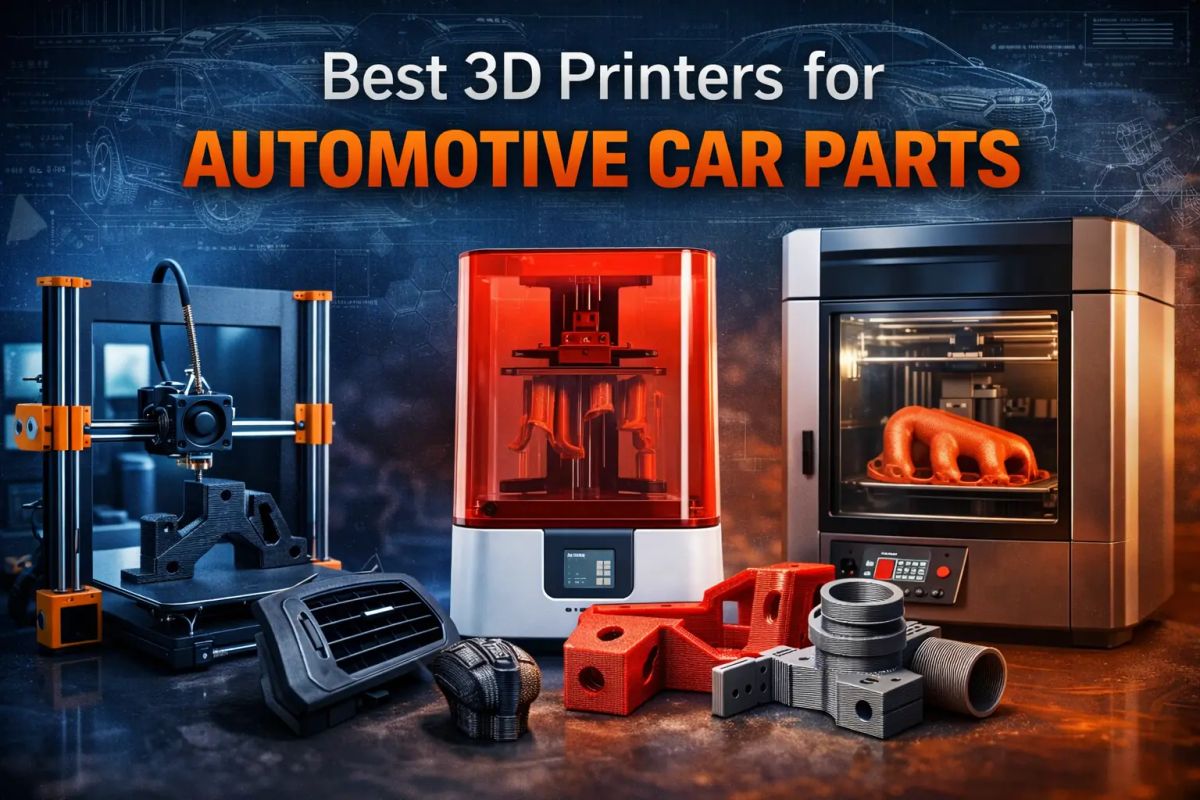
Best 3D Printers for Car Parts UK: 2026 Buyer's Guide
Choosing the right 3D printer for making car parts requires different considerations than general hobby printing. Automotive applications demand reliability, material compatibility, and the ability to produce functional parts that survive real-world conditions. This guide focuses on what actually matters when printing brackets, mounts, and components for vehicles.
If you're new to 3D printing car parts, start with our overview: 3D Printing Car Parts: What's Possible, What's Safe, and What Actually Works
What Makes a 3D Printer Suitable for Automotive Parts?
Not all 3D printers are created equal when it comes to automotive applications. Here's what actually matters:
Essential Features for Automotive Printing
Nice-to-Have Features
- Enclosure: Not required for PET-CF, but helpful for PA-based materials
- Direct Drive Extruder: Better for flexible materials and high-temp filaments
- Filament Runout Sensor: Prevents failed 12+ hour prints
- Power Loss Recovery: Resume printing after power cuts
- Network Connectivity: Monitor prints remotely
Budget Tiers: What to Expect at Each Price Point
Entry Level: £200-400
What you get:
- Basic FDM printing capability
- Adequate for PETG and PLA
- Usually requires upgrades for carbon fibre materials
- Smaller build volumes (180-220mm cube)
- Manual bed leveling common
Suitable for:
- Interior trim pieces
- Prototyping before final prints
- Learning 3D printing basics
- PETG brackets and clips
Not suitable for:
- Carbon fibre filaments (without nozzle upgrade)
- Large under-bonnet parts
- High-volume production
Mid-Range: £400-800
What you get:
- All-metal hotend (usually)
- Auto bed leveling
- Better build volumes (220-250mm cube)
- More reliable prints
- Often comes with hardened nozzle or easy to upgrade
Suitable for:
- PET-CF and PAHT-CF printing
- Under-bonnet brackets and mounts
- Reliable production of functional parts
- Most automotive applications
This is the sweet spot for automotive printing.
Professional: £800-2000+
What you get:
- Enclosed chambers (standard)
- Advanced features (filament sensors, cameras)
- Larger build volumes (300mm+ cubes possible)
- Multi-material capability
- Excellent reliability and support
Suitable for:
- Small garage/business use
- High-temperature materials
- Large or complex parts
- Consistent production quality
Recommended Printers by Category (2026 Edition)
Best Overall for Automotive: Bambu Lab A1 Combo (£399-499)
The A1 Combo represents the best value for automotive printing in 2026, offering CoreXY speed and reliability at an unprecedented price point.
Key Specifications:
- Build Volume: 256 x 256 x 256mm
- Hotend Temperature: 300°C max
- Bed Temperature: 100°C max
- CoreXY motion system
- Includes AMS Lite (4-color automatic material system)
- Auto bed leveling and calibration
- Active chamber heating available
Why it's excellent for automotive:
- Native support for PET-CF and PAHT-CF
- Faster than previous generation (CoreXY vs bed slinger)
- Enclosed chamber with active heating option
- Built-in camera for monitoring long prints
- AMS Lite included for multi-material printing
- Excellent value at under £500
UK Price: ~£399-499 (with AMS Lite)
Premium Pick: Bambu Lab X1E (£1,299-1,499)
The X1E (2026 successor to X1-Carbon) offers industrial-grade capabilities for serious automotive work.
Key Specifications:
- Build Volume: 256 x 256 x 296mm (taller Z-axis)
- Hotend Temperature: 350°C (high-temp materials)
- Advanced chamber heating (60°C+)
- AI camera with failure detection
- Hardened nozzle standard
- Enterprise-grade reliability features
Why it's excellent for professional use:
- Handles extreme materials (PC-CF, PEEK)
- Extended build height for larger parts
- Better suited for high-volume production
- Advanced monitoring and remote management
- Longest warranty in Bambu lineup
UK Price: ~£1,299-1,499
Best Large Format: Bambu Lab HD2 (£2,499-2,799)
New for 2026, the HD2 offers significantly larger build volume for automotive applications requiring bigger parts.
Key Specifications:
- Build Volume: 400 x 400 x 400mm (massive)
- Hotend Temperature: 300°C
- Fully enclosed with active heating
- Dual independent Z-axis
- Built for heavy-duty applications
- Industrial-grade components
Why it's ideal for large automotive parts:
- Print full panels and large covers in one piece
- Extended ducting and intake components
- Large prototype parts without splitting
- Professional garage and workshop use
- Handles full-width dashboard sections
UK Price: ~£2,499-2,799
Note: Only recommended if you regularly need parts >256mm cube
Best Budget Option: Creality Ender 3 V3 SE (£200-250)
Key Specifications:
- Build Volume: 220 x 220 x 250mm
- All-metal hotend
- Auto bed leveling (CR Touch)
- Dual-gear extruder
Why it works for automotive:
- Can print PETG and PET-CF (with nozzle upgrade)
- Large community support
- Easy to upgrade (hardened nozzle ~£15-25)
- Good build volume for small to medium parts
Limitations:
- No enclosure (makes PA materials harder)
- Requires nozzle upgrade for carbon fibre
- Not as reliable as higher-end options
- Manual tuning often needed
UK Price: ~£200-250
Plus hardened nozzle: ~£15-25
Still Available: Bambu Lab P1S (£549-649)
The P1S remains available in 2026 as a value option, though largely superseded by the A1 series.
Key Specifications:
- Build Volume: 256 x 256 x 256mm
- 300°C hotend
- Enclosed design
- Bed-slinger motion (slower than CoreXY)
- No AMS included (optional extra)
Why you might still choose it:
- Slightly cheaper than A1 if you don't need AMS
- Proven reliability and track record
- Large existing user community
UK Price: ~£549-649
However: For most users in 2026, the A1 Combo offers better value with newer technology and included AMS Lite.
Best Alternative: Prusa MK4S (£799-999)
The MK4S (2026 refresh) remains the choice for those valuing open-source and legendary support.
Key Specifications:
- Build Volume: 250 x 210 x 220mm
- 300°C nozzle temperature
- Improved auto bed leveling
- Direct drive extruder
- Nextruder 2.0 (refined version)
- Open source firmware
Why it's solid for automotive:
- Legendary reliability and support
- Active community and modifications
- Easy to repair and maintain
- No vendor lock-in on materials
- Open-source firmware benefits
Limitations:
- No enclosure (add-on available for ~£200-300)
- Open-frame design makes PA materials harder
Running a UK garage?
Independent UK garages use AutoChain to win more repeat work, cut admin, and compete with national chains.
Start 14-day free trial →- Slower than Bambu CoreXY printers
- More expensive than equivalent Bambu models
UK Price: ~£799-999 (kit or assembled)
Consider if: You value open-source, plan to modify heavily, or want absolute control over your printer
Feature Comparison: Top 2026 Picks
Material Compatibility: What Each Printer Handles Well
PET-CF (205°C HDT - Best for Automotive)
Works great with (2026 models):
- ✅ Bambu Lab A1 Combo (native support, optimized profiles, active chamber)
- ✅ Bambu Lab X1E (native support, advanced chamber control)
- ✅ Bambu Lab HD2 (native support, large format)
- ✅ Bambu Lab P1S (native support)
- ✅ Prusa MK4S (with hardened nozzle)
- ✅ Creality Ender 3 V3 SE (with hardened nozzle upgrade)
Requirements:
- Hardened steel nozzle (0.4mm or 0.6mm)
- 250-260°C printing temperature
- 80-90°C bed temperature
- No enclosure needed (but helps consistency)
PAHT-CF (194°C HDT - High Impact)
Works well with (2026 models):
- ✅ Bambu Lab X1E (advanced chamber heating, native support)
- ✅ Bambu Lab A1 Combo (active chamber heating, native support)
- ✅ Bambu Lab HD2 (industrial enclosure, native support)
- ✅ Bambu Lab P1S (enclosed, native support)
- ⚠️ Prusa MK4S (with enclosure add-on)
- ❌ Open-frame printers (difficult, warping issues)
Requirements:
- Hardened steel nozzle
- Enclosed chamber (highly recommended)
- Active chamber heating (ideal)
- Filament dryer
- 270-290°C printing temperature
PETG (Good for Interior Parts)
Works with everything:
- ✅ All printers listed
- Easy to print
- No special requirements
- 230-250°C printing temperature
PET-CF is the ideal material for automotive parts because:
- Works on mid-range and budget printers (with hardened nozzle)
- No enclosure required
- No drying needed before printing
- Highest heat deflection temperature (205°C)
- Excellent mechanical properties
This means you can get great results without buying the most expensive printer.
Build Volume Considerations for Car Parts
Automotive parts tend to be larger than typical hobbyist prints. Here's what you can expect to fit:
Small Build Volume (180-200mm cube)
Can print:
- Small brackets and clips
- Cable management parts
- Sensor mounts
- Interior trim pieces
- Most dashboard components
Cannot print:
- Large ducting
- Full-width trim panels
- Large battery covers
- Extended brackets
Medium Build Volume (220-250mm cube)
Can print:
- Most automotive applications
- Under-bonnet brackets and mounts
- Air intake components
- Medium-sized covers and housings
- Reservoir mounts
- ECU brackets
This size handles 90% of automotive 3D printing needs.
Large Build Volume (300-400mm+ cube)
Can print:
- Very large custom parts
- Full panels and covers (one piece)
- Extended ducting systems
- Large prototype parts
- Complete dashboard sections
- Full-width trim panels
2026 Update: The Bambu Lab HD2 (400mm cube) makes large format accessible for professional workshops at £2,499-2,799. Previously required industrial printers costing £5,000+.
Essential Upgrades and Accessories
Must-Have Additions
Useful but Optional
- Filament dryer (£40-80): Essential for PA materials, not needed for PET-CF
- Enclosure (£100-200 for DIY, £200-400 for commercial): Needed for PA materials
- Extra build plates (£20-40 each): Convenience for different materials
- Tool kit (£20-40): Allen keys, scrapers, wrenches
- Camera (£20-50): Monitor long prints remotely (built-in on Bambu Lab)
What About Multi-Material Printing?
Multi-material capability (printing multiple colors or materials in one part) is a nice feature but not essential for automotive applications.
When it's useful:
- Color-coding parts
- Combining rigid and flexible materials
- Adding labels or markings to parts
- Prototyping with different material zones
When it's overkill:
- Functional brackets (single material is fine)
- Under-bonnet parts (aesthetics don't matter)
- Most repair applications
Cost consideration: Multi-material systems (like Bambu Lab AMS) add £250-400 to the printer cost. For automotive work, spend that money on better materials or more filament instead.
Printer Reliability: What Actually Matters
For automotive applications where parts may be safety-adjacent or under-bonnet, print reliability is critical.
Signs of a Reliable Printer
✅ Consistent first layers - Most print failures happen here
✅ Accurate temperature control - Critical for engineering materials
✅ Tight mechanical tolerances - Parts fit properly without post-processing
✅ Good community support - Help when you need it
✅ Available spare parts - UK suppliers with reasonable prices
Red Flags
❌ Frequent failed prints requiring constant re-tuning
❌ Temperature fluctuations during printing
❌ Bed adhesion problems that never fully resolve
❌ Poor customer support or difficult warranty claims
❌ Proprietary parts that are hard to source in UK
UK-Specific Buying Considerations
Where to Buy in the UK
Official UK Distributors (Recommended):
- Bambu Lab UK Store - Bambu Lab printers, official warranty
- Prusa Research UK - Ships from Czech Republic, excellent support
- 3DJake UK - Wide range of printers and materials
- Box.co.uk - Good UK supplier
- Technology Outlet - Competitive pricing
Avoid:
- Unknown Amazon sellers (warranty issues)
- Grey market imports (no UK warranty)
- Very cheap eBay printers (quality and support problems)
UK Warranty and Support
- Bambu Lab: 1-year warranty, UK support available
- Prusa: 2-year warranty (EU), excellent customer service
- Creality: 1-year warranty, support can be hit-or-miss
- Budget brands: Often limited or no UK support
Shipping and Import Costs
- UK-based stock: No additional fees, fast delivery (2-5 days)
- EU imports: Potential customs delays, VAT already included post-Brexit
- Non-EU imports: Add 20% VAT + customs fees + courier handling (avoid unless unavoidable)
Always buy from UK stock or official EU distributors to avoid customs complications.
Recommended Starter Setup for Automotive Printing
Budget Setup: ~£250-300
- Printer: Creality Ender 3 V3 SE (£200-250)
- Hardened nozzle: 0.4mm (£15-25)
- Calipers: Digital calipers (£10-15)
- Materials: 1kg PET-CF (£80)
- Total: ~£305-370
What you can do:
- Print PETG interior parts immediately
- Print PET-CF under-bonnet parts (after nozzle upgrade)
- Learn 3D printing basics
- Produce functional automotive components
Limitations:
- Requires more tuning and troubleshooting
- No enclosure (PA materials difficult)
- Manual intervention sometimes needed
Recommended Setup 2026: ~£550-700
- Printer: Bambu Lab A1 Combo (£399-499) — includes AMS Lite
- Spare nozzle: 0.6mm hardened steel (£15-20)
- Calipers: Digital calipers (£10-15)
- Materials: 2kg PET-CF, 1kg PAHT-CF (£240-260)
- Accessories: Spare build plate, IPA, tools (£40-50)
- Total: ~£704-844
What you can do:
- Print virtually any automotive part
- Reliable CoreXY speed and quality
- Both PET-CF and PAHT-CF materials
- 4-color/material capability included
- Minimal tuning required
- Active chamber heating for PA materials
This is the optimal setup for serious automotive printing in 2026.
Professional Setup 2026: ~£1,500-1,800
- Printer: Bambu Lab X1E (£1,299-1,499)
- Filament dryer: Bambu Lab dryer (£80-100)
- Multiple nozzles: Various sizes (£60-80)
- Materials: 5kg variety (£400-500)
- Tools & accessories: Complete toolkit (£100)
- Total: ~£1,939-2,279
For small garages or businesses doing regular automotive 3D printing.
Advantages over A1:
- Higher chamber temperatures (better PA performance)
- 350°C hotend (exotic materials)
- Taller build height (296mm vs 256mm)
- Industrial reliability features
- Better for high-volume production
Large Format Setup: ~£2,800-3,200
- Printer: Bambu Lab HD2 (£2,499-2,799)
- Materials: 10kg variety for large prints (£800-900)
- Large format accessories: (£100-150)
- Total: ~£3,399-3,849
Only if you regularly need parts over 256mm cube - dashboard panels, full intake systems, large covers
Common Mistakes to Avoid
1. Buying Based on Speed Alone
The mistake: Choosing a printer advertised as "500mm/s!" for automotive work.
Why it's wrong: Functional automotive parts need strength and accuracy, not speed. You'll print at 60-150mm/s anyway for quality.
Do instead: Focus on material compatibility and reliability.
2. Skipping the Hardened Nozzle
The mistake: Trying to print PET-CF with a brass nozzle.
Why it's wrong: Brass wears out in 100-500g of carbon fibre filament, causing poor quality and failed prints.
Do instead: Buy hardened steel nozzles (£15-25) from day one.
3. Buying Too Small
The mistake: Getting a 180mm cube build volume to save £100.
Why it's wrong: You'll quickly hit size limits with automotive parts and regret the decision.
Do instead: Minimum 220mm cube, ideally 250mm+ cube build volume.
4. Ignoring Enclosures for PA Materials
The mistake: Buying an open-frame printer and expecting PAHT-CF to print well.
Why it's wrong: PA-based materials warp badly without consistent ambient temperature.
Do instead: Either buy enclosed printer or stick with PET-CF (doesn't need enclosure).
5. Not Researching UK Support
The mistake: Buying a cheap unknown brand from AliExpress.
Why it's wrong: When (not if) you need help or parts, there's no UK support or spare parts.
Do instead: Buy from established brands with UK presence or strong community support.
Conclusion: Which Printer Should You Buy in 2026?
For most people printing automotive parts in the UK in 2026, the Bambu Lab A1 Combo (£399-499) is the outstanding choice. It offers CoreXY speed, handles PET-CF beautifully, includes AMS Lite for multi-material, and provides professional results at an unbeatable price point.
If your budget allows: The X1E (£1,299-1,499) is the premium choice, with advanced chamber heating, 350°C hotend capability, and extended build height for larger parts.
If you need large format: The HD2 (£2,499-2,799) is the only consumer option for parts over 256mm cube, ideal for professional workshops printing full panels and large components.
If budget is very tight: The Creality Ender 3 V3 SE (£200-250) + hardened nozzle (£15-25) remains a solid entry point, though expect more hands-on tuning.
If you value open-source: Prusa MK4S (£799-999) has legendary customer service and community support, though it costs significantly more than the A1 and lacks enclosure.
Key Takeaways 2026
✅ A1 Combo is the best value - CoreXY speed + AMS Lite included at £399-499
✅ Material compatibility matters most - All Bambu models handle PET-CF natively
✅ Build volume sweet spot is 256mm cube - Handles 90% of automotive parts
✅ Active chamber heating is standard - 2026 models handle PA materials much better
✅ Hardened steel nozzle is essential - Budget £15-25 for this upgrade
✅ Buy from UK suppliers - Avoid customs issues and ensure warranty support
Ready to start printing? Read our main guide: 3D Printing Car Parts: What's Possible, What's Safe, and What Actually Works
Related Articles
3D Printing for Automotive:
- 3D Printing Car Parts: What's Possible, What's Safe, and What Actually Works - Complete overview guide
- 3D Printed Parts for Electric Vehicles: Opportunities and Applications - EV-specific printing guide
- How to Anneal 3D Printed Car Parts - Optional post-processing guide
Vehicle Maintenance:
- What Maintenance & Repairs Do Electric Cars Need - EV maintenance overview
- Will Independent Garages Survive the EV Transition - Future of automotive repair
- Digital Service History Guide - Track modifications and repairs
About the Author: The AutoChain Team includes mechanical engineers, 3D printing specialists, and automotive technicians with hands-on experience in additive manufacturing for vehicle applications. We test and evaluate technologies to help UK vehicle owners and independent garages adopt practical repair solutions.

Ready to run a smarter garage?
Start your 14-day free trial today.
No card required. Get set up in under 10 minutes.