Will Independent Garages Survive the EV Transition?
As electric vehicles reshape the UK automotive aftermarket, independent garages face a critical crossroads. Explore the challenges, opportunities, and skills needed for survival in the EV era.
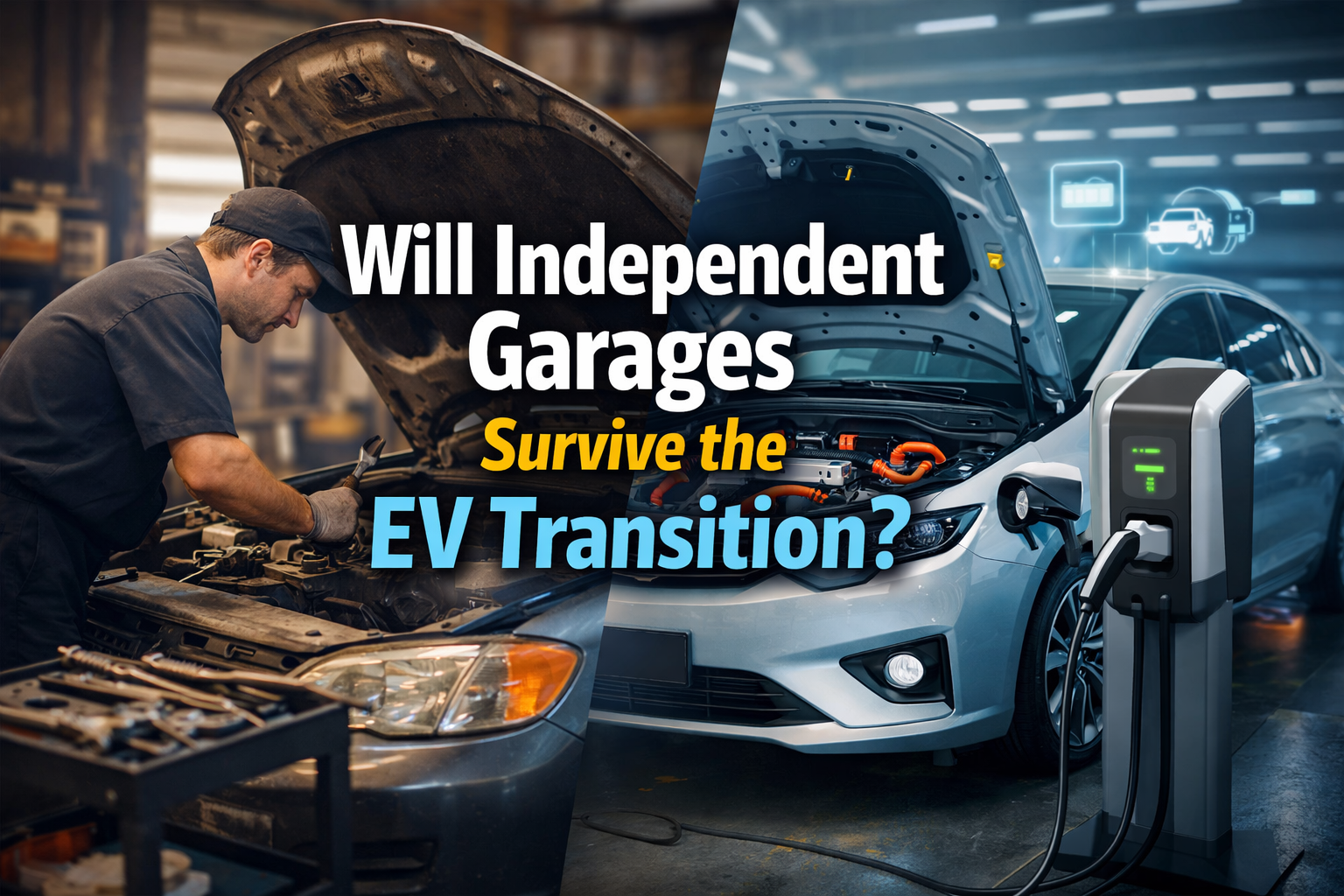
Will independent garages survive the EV transition - automotive aftermarket analysis
Will Independent Garages Survive the EV Transition?
The rapid growth of electric vehicles (EVs) is reshaping the UK automotive aftermarket, and independent garages are standing at a critical crossroads. As EV ownership rises, questions are emerging about who will repair and maintain these vehicles in the long term — and whether independent garages risk being squeezed out by franchised dealers.
This is not a story about inevitable decline. It is about adaptation, skills, and ensuring a competitive, consumer-friendly repair market as the UK transitions away from petrol and diesel cars.
Key Insight
Independent garages are not facing extinction, but they are facing transformation. EV skills will determine long-term survival in the automotive aftermarket.
EV Repairs and the Growing Dealer Advantage
EV repair work is already beginning to skew towards franchised dealers. Backed by manufacturers, dealer networks have invested heavily in EV training, high-voltage safety certification, specialist tooling and early access to electric vehicle platforms.
Independent garages face a very different reality. Many are focused on keeping an ageing internal combustion engine (ICE) fleet on the road, while also investing in increasingly complex ICE diagnostics. With tight margins, staff shortages and mixed government messaging on EV timelines, committing significant money to EV training can feel like a risky decision.
As a result, many EVs that leave warranty are still funnelled back to franchised dealers, not because independents lack skill, but because the opportunity and support to upskill has not been evenly distributed.
The Training Gap
The EV training and support gap between franchised dealers and independent garages is widening. Without intervention, this risks creating a two-tier repair market.
Why a Competitive EV Repair Market Matters
A healthy independent garage sector has always been essential for consumer choice, fair pricing and local convenience. If EV repairs become concentrated in a small number of dealer networks, motorists are likely to face higher costs, longer waiting times and fewer repair options — particularly as vehicles age.
There is also a wider impact on EV adoption. Drivers may hesitate to switch to electric if they believe repairs will be expensive or difficult once manufacturer warranties expire. In this way, a restricted EV aftermarket risks slowing the broader transition to cleaner mobility.
Dealer-Only Market Impact
Higher repair costs, longer wait times, limited local options, potential reluctance to buy EVs post-warranty.
Competitive Market Benefits
Fair pricing through competition, convenient local repairs, consumer choice, confidence in long-term EV ownership.
Will Independent Garages Disappear?
Independent garages are not about to fizzle out, but the direction of travel is clear. There will be strong demand for petrol and diesel repairs for many years yet. Exhausts, engine servicing, turbos, spark plugs and fuel system repairs remain core income streams today, supported by a large and ageing ICE vehicle parc.
However, relying exclusively on this work carries long-term risk. New ICE registrations are already falling, and as EVs make up a larger share of vehicles on the road, the pool of cars needing traditional engine work will steadily shrink.
Garages that delay EV upskilling indefinitely risk missing out on a growing proportion of future repair work.
According to the Society of Motor Manufacturers and Traders, battery electric vehicle registrations continue to grow year-on-year, with the government targeting 80% of new car sales to be zero-emission by 2030 under the Zero Emission Vehicle mandate.
What Support Independent Garages Need
The EV transition does not have to result in a monopolised repair market. Industry bodies including the Independent Garage Association are calling for coordinated action involving government, training providers and policymakers to ensure independent garages are not left behind.
| Support Type | Description | Potential Impact |
|---|---|---|
| Subsidised EV Training | Government-backed grants for IMI Level 2-4 EV qualifications | Reduces financial barrier to upskilling |
| Small Business Grants | Targeted funding for EV equipment and tooling | Enables practical capability without prohibitive investment |
| Long-term Policy Clarity | Consistent messaging on EV timelines and mandates | Gives garages confidence to invest in EV training |
| Access to Technical Data | Right to repair legislation for independent access | Levels the playing field with franchised dealers |
With the right support, independent garages can gradually build EV capability alongside existing ICE work, rather than being forced into a sudden or unrealistic transition.
Modern garage management software can help independent garages streamline operations, reduce administrative overhead, and free up resources for EV training and equipment investment. By automating routine tasks like job scheduling, invoicing, and customer communication, garages can focus on building the skills and capabilities needed for the EV transition.
What Happens to Traditional ICE Work?
For the foreseeable future, ICE repairs will continue to generate reliable income. The average age of vehicles on UK roads continues to rise, and petrol and diesel cars will remain common well into the 2030s.
Over time, however, traditional work such as exhaust replacement, fuel system repairs and engine servicing will decline as older ICE vehicles are scrapped and replaced. This change will be gradual, but unavoidable.
Forward-thinking garages are already treating ICE work as today's revenue stream, while preparing EV capability as tomorrow's core business.
Strategic Approach
The most resilient garages are those that maintain strong ICE capabilities today while gradually building EV skills through training, partnerships, or specialist referrals.
What Will the Automotive Aftermarket Look Like by 2040?
By 2040, most vehicles on UK roads are expected to be electric or zero-emission. ICE vehicles will still exist, but they will form a much smaller and increasingly niche segment of the fleet.
Independent garages that depend almost entirely on engine-based repairs will struggle due to reduced volume. Those that have invested in EVs, hybrids, diagnostics, calibration and electronic systems are far more likely to remain competitive.
The independent sector is not disappearing — it is evolving.
What Maintenance and Repairs Do Electric Cars Need?
Electric vehicles still require regular servicing and repair, but the focus shifts away from engines and exhausts toward chassis, electronics and high-voltage systems.
| Work Category | Common Jobs | Skill Level |
|---|---|---|
| Tyres and Brakes | Tyre replacement, alignment, brake servicing (EVs are heavier, more tyre wear) | Existing skills + EV awareness |
| Suspension and Steering | Shock absorbers, bushes, wheel bearings, geometry | Existing skills apply |
| High-Voltage Systems | Battery health diagnostics, inverter faults, charging system issues | IMI Level 2-3 HV certification required |
| Cooling Systems | Battery and motor cooling, thermal management | EV-specific training needed |
| Electronics and Software | Software updates, sensor calibration, 12V battery replacement | Advanced diagnostics and EV training |
| Standard Servicing | Air-con, wipers, lights, MOT prep, fluids | Existing skills apply |
EVs are often heavier and produce instant torque, which can increase tyre wear. Cooling systems for batteries and motors, software updates, charging system faults, inverter issues and battery health diagnostics are becoming central areas of workshop expertise.
Alongside this, familiar jobs such as 12-volt battery replacement, lighting faults, wipers, wheel bearings and MOT-related safety repairs remain everyday work for local garages.
Good News for Independents
Much of EV servicing involves existing skills. Brakes, tyres, suspension, air-con and MOT work are still needed. The key additions are high-voltage safety awareness and diagnostics.
The Bottom Line for Independent Garages
Independent garages are not facing extinction, but they are facing transformation. ICE work will continue to pay the bills in the short to medium term, but EV skills will determine long-term survival.
Garages that begin adding EV and electrical capability over the next decade are likely to remain relevant well into 2040 and beyond. Those that ignore the shift entirely risk being sidelined as the vehicle fleet changes.
The EV future does not have to belong solely to franchised dealers. With the right support and a proactive approach to upskilling, independent garages can remain a vital, competitive part of the UK automotive aftermarket.
Ready to modernise your garage operations? AutoChain's garage management software helps independent garages streamline workflows, reduce costs, and prepare for the EV transition. With features like digital job cards, AutoChain Advance Intelligence, and smart scheduling, you can free up time and resources to invest in EV training and equipment. Get started today with a monthly rolling contract—no long-term commitments.
Why Choose AutoChain for Your Vehicle Needs
⚡ EV-Ready Network: Access to garages with EV training and high-voltage certification for electric vehicle servicing and repairs.
🔧 ICE Expertise: Comprehensive coverage for petrol and diesel vehicles with experienced independent garages nationwide.
📱 Digital Service History: Complete digital records whether you drive an EV, hybrid, petrol or diesel vehicle.
💷 Transparent Pricing: Fair, competitive pricing across our network with no dealer premium markups.
Whether you're driving an electric vehicle or a traditional petrol or diesel car, AutoChain connects you with trusted independent garages that can service and repair your vehicle to the highest standards.
Find a garage near you or learn more about our services.
Sources: