Will EV Repairs Be Dealer-Controlled?
Growing concern that EV repairs could become dealer-dominated. Discover why independent garage access matters for pricing, choice and EV adoption.
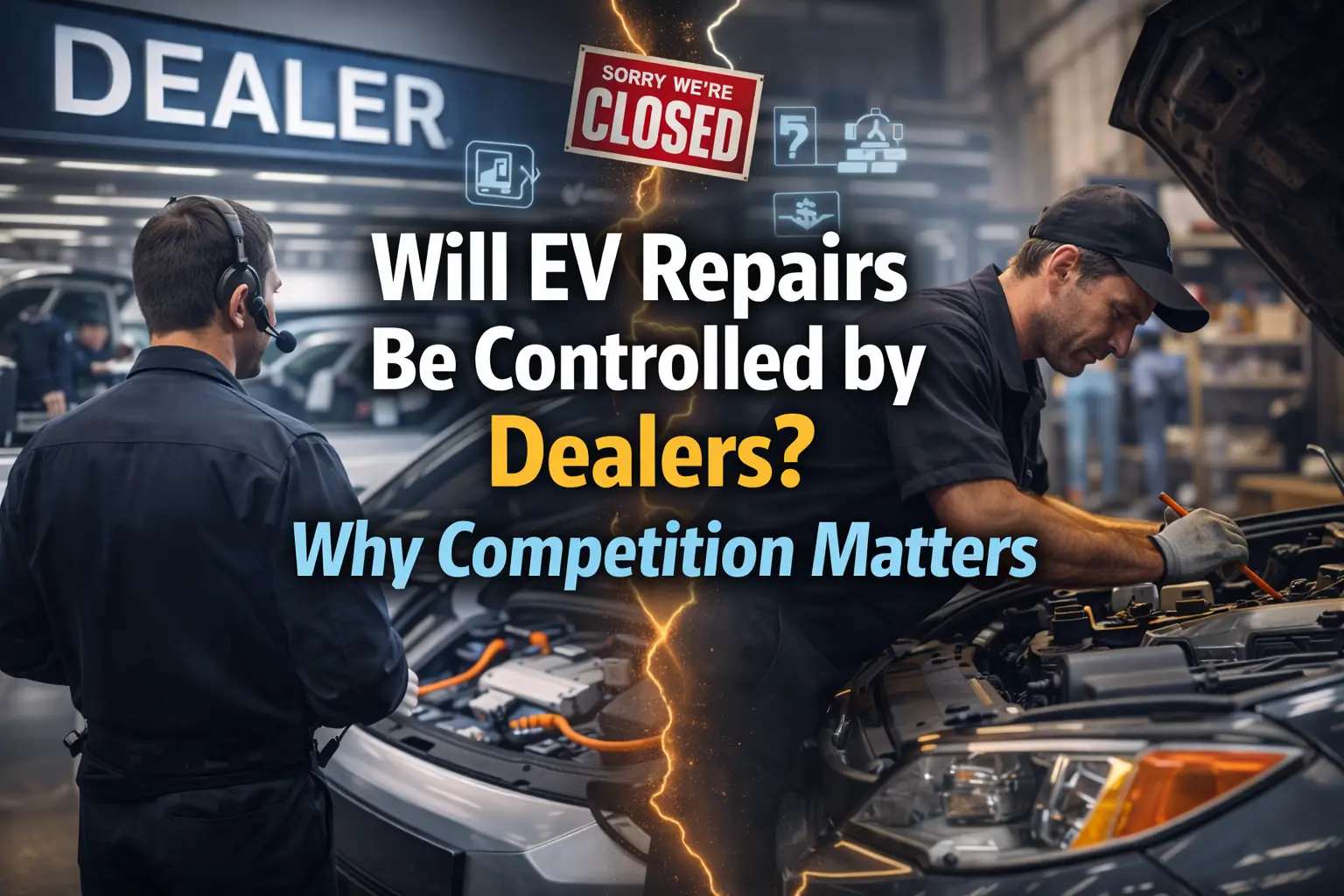
Dealers vs independent garages for EV repairs - competition and consumer choice
Will EV Repairs Be Controlled by Dealers? Why Competition Matters
There is growing concern within the automotive aftermarket that EV repairs could become concentrated within franchised dealer networks. Dealers benefit from manufacturer-backed training programmes, direct technical support, specialist tools and early exposure to new electric vehicle platforms.
This naturally positions them as default repairers when EVs leave warranty, particularly if independent garages lack access to training or feel excluded from high-voltage work.
Market Concentration Risk
If independent garages are pushed out of EV repairs, motorists face higher prices, longer waiting times and fewer choices — especially for older EVs.
The Dealer Advantage Is Real
Franchised dealers have significant structural advantages when it comes to EV repairs:
| Advantage | Impact | Independent Gap |
|---|---|---|
| Manufacturer Training | Early access to EV-specific courses and certification | Training often unavailable or unaffordable for independents |
| Technical Support | Direct manufacturer helplines and diagnostic support | Limited or no access to manufacturer systems |
| Specialist Tooling | Manufacturer-provided high-voltage equipment | Must self-fund expensive equipment without volume guarantee |
| Software Access | Official diagnostic platforms and software updates | Right to repair legislation still being implemented |
These advantages are not accidental — they are built into the franchise model. The question is whether this creates an unfair barrier to competition as the vehicle fleet shifts to electric.
What Happens When Competition Disappears?
If independent garages are pushed out of EV repairs, the consequences for motorists are clear. Reduced competition typically leads to higher prices, longer waiting times and fewer choices.
For owners of older EVs, this is especially problematic, as repair affordability becomes more important once manufacturer support diminishes.
Impact of Dealer-Only vs. Competitive EV Repair Market
Dealer Monopoly ❌ Higher labour rates, premium pricing, limited appointment availability, pressure to use OEM parts, potential upselling
Competitive Market ✅ Fair pricing through competition, local convenience, flexible service options, alternative parts availability, consumer choice
A strong independent sector has always acted as a balancing force against dealer dominance. It keeps pricing competitive, improves accessibility and ensures drivers are not locked into a single repair channel.
The Impact on EV Adoption
There is also a wider implication for EV adoption. Drivers considering a switch to electric may hesitate if they believe repairs will be expensive, inconvenient or restricted to main dealers.
In that sense, a monopolised EV repair market does not just affect garages — it risks slowing the transition to electric vehicles altogether.
Consumer Psychology
Many drivers delay buying EVs due to concerns about post-warranty repair costs. A healthy independent repair sector builds confidence in long-term EV ownership.
According to consumer research by the Competition and Markets Authority, access to competitive repair options is a significant factor in vehicle purchase decisions, particularly for cost-conscious buyers.
Right to Repair: The Policy Response
Ensuring independent garages can access EV training, tooling and technical information is therefore not just an industry issue. It is a consumer protection issue and a competition issue.
The UK government and EU have introduced "right to repair" measures aimed at ensuring fair access to:
- Technical repair information
- Diagnostic software and tools
- Spare parts at reasonable prices
- Training and certification programmes
However, implementation has been slow, and many independent garages report continued barriers to accessing manufacturer systems and data.
| Access Need | Current Status | Barrier |
|---|---|---|
| Technical repair manuals | Partial access | Complex licensing, high subscription costs |
| Diagnostic software | Limited availability | Manufacturer restrictions, expensive licenses |
| Software updates | Mostly dealer-only | Manufacturers retain control, security concerns cited |
| Subsidised training | Limited schemes | No coordinated national programme for independents |
Further reading: Independent Garage Association - Right to Repair Campaign
What Independent Garages Can Do Now
While waiting for policy changes, forward-thinking independent garages are taking proactive steps:
- Invest in IMI Level 2-3 EV training for at least one technician
- Build partnerships with EV specialists for sub-contract work
- Join independent garage networks for shared training and tools
- Focus on non-high-voltage EV work (tyres, brakes, suspension, 12V systems)
- Streamline operations with garage management software to free time and budget for training and tooling
- Lobby through trade bodies for better access and support
Related article: EV Training for Independent Garages - What Skills Will Matter Most?
The Bottom Line
The EV repair market does not have to become dealer-dominated. With proper policy support, fair access to training and technical information, and proactive upskilling, independent garages can remain competitive.
This matters for:
- ✅ Consumer choice and fair pricing
- ✅ Local convenience and accessibility
- ✅ Confidence in post-warranty EV ownership
- ✅ Healthy competition in the automotive aftermarket
The fight to maintain a competitive EV repair market is not over — but it requires action from government, industry bodies and garages themselves.
Why Choose AutoChain
AutoChain supports both franchised dealer standards and independent garage value. Our network includes:
- Garages with EV training and certification
- Competitive pricing without dealer premiums
- Local convenience across the UK
- Transparent service history for all vehicles
Find a trusted garage near you today.
Related Articles:
- Will Independent Garages Survive the EV Transition?
- What Maintenance and Repairs Do Electric Cars Need?
- EV Training for Independent Garages
- How Long Will Petrol and Diesel Repairs Still Be Needed?
Frequently Asked Questions
Can I take my EV to an independent garage for servicing? Yes. There is no legal requirement for EV servicing to be carried out by a main dealer. The Motor Vehicle Block Exemption Regulations protect your right to have your vehicle serviced at any qualified garage without voiding a manufacturer warranty, provided the service meets the manufacturer's specification. For warranty-covered repairs under a new vehicle guarantee, you will need to use an authorised dealer. But for routine maintenance — tyre rotations, brake fluid changes, cabin filter replacements, and general inspections — any qualified independent garage can legally carry out the work. Ensure the garage employs IMI-qualified EV technicians and uses the correct servicing procedures for your specific vehicle.
Why do car manufacturers want to control EV repair data? Car manufacturers argue that access restrictions on EV diagnostic and repair data are necessary for safety (high-voltage systems require trained technicians) and to protect proprietary software. Critics, including the Independent Garage Association and the Motor Ombudsman, argue that these restrictions go beyond safety and amount to anti-competitive practices designed to keep repair revenue within dealer networks. The UK government and the European Parliament have both been examining right-to-repair legislation that would require manufacturers to share repair data with independent repairers on fair and reasonable terms. The outcome of these regulatory debates will significantly shape the independent garage sector's ability to service EVs competitively in the years ahead.
What maintenance do electric cars actually need? Electric cars need less maintenance than petrol or diesel vehicles overall, but they are not maintenance-free. Key maintenance items include tyre checks and rotation (EVs wear tyres faster due to heavier weight and instant torque), brake fluid changes (typically every two years, as moisture absorption is time-related rather than mileage-related), cabin air filter replacement, coolant checks for the battery thermal management system, and regular software updates. The 12V auxiliary battery also needs periodic checking and replacement, just as in any vehicle. Brakes typically last longer on EVs due to regenerative braking reducing pad and disc wear. Total annual maintenance costs for EVs are generally 30–40% lower than equivalent ICE vehicles.